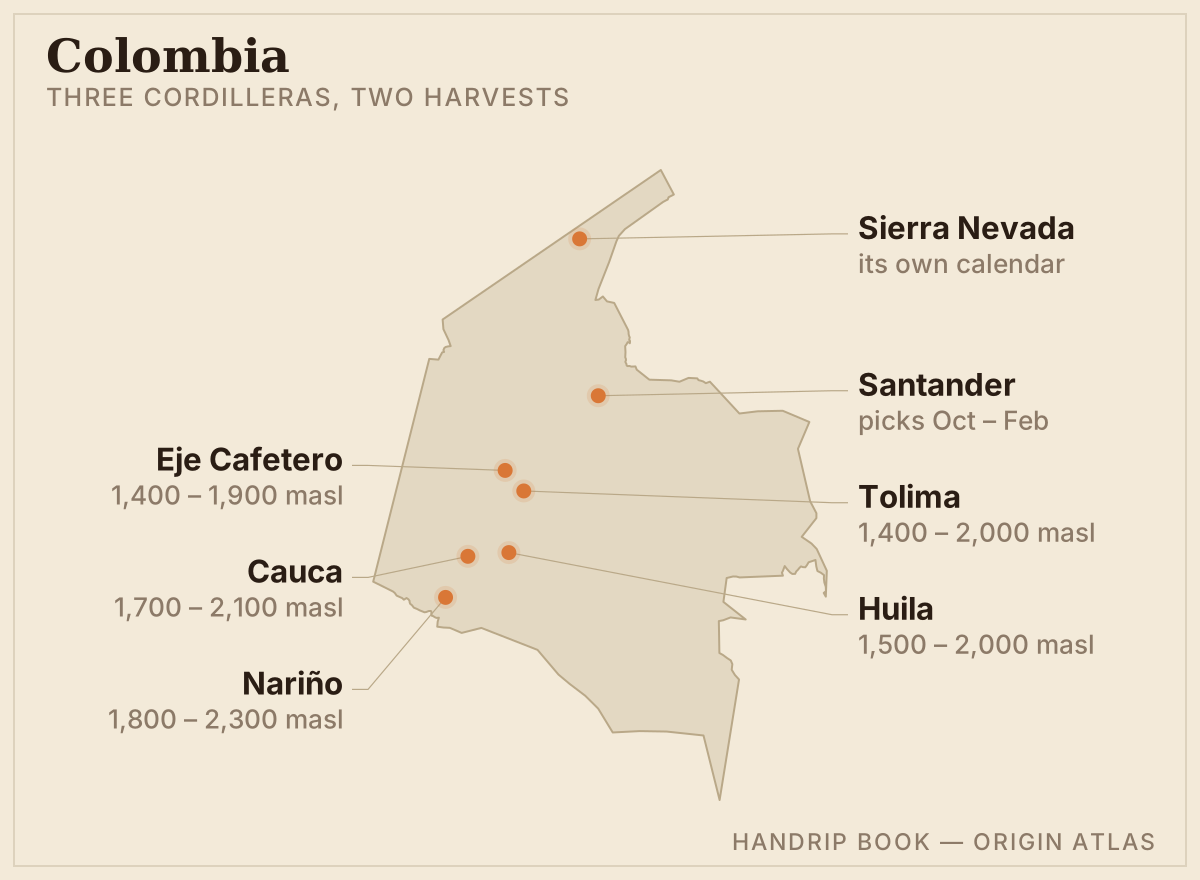
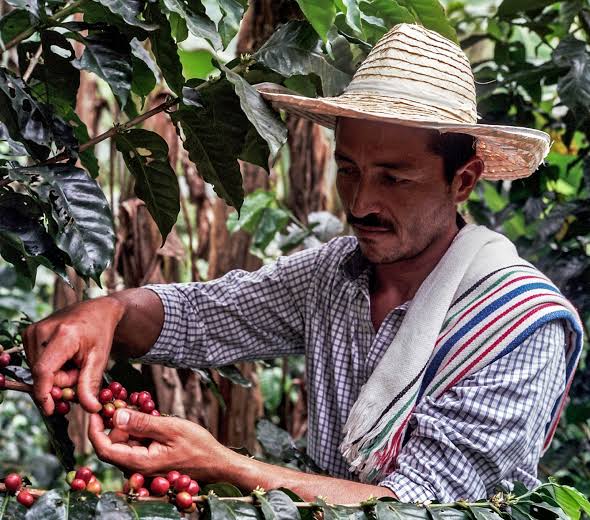
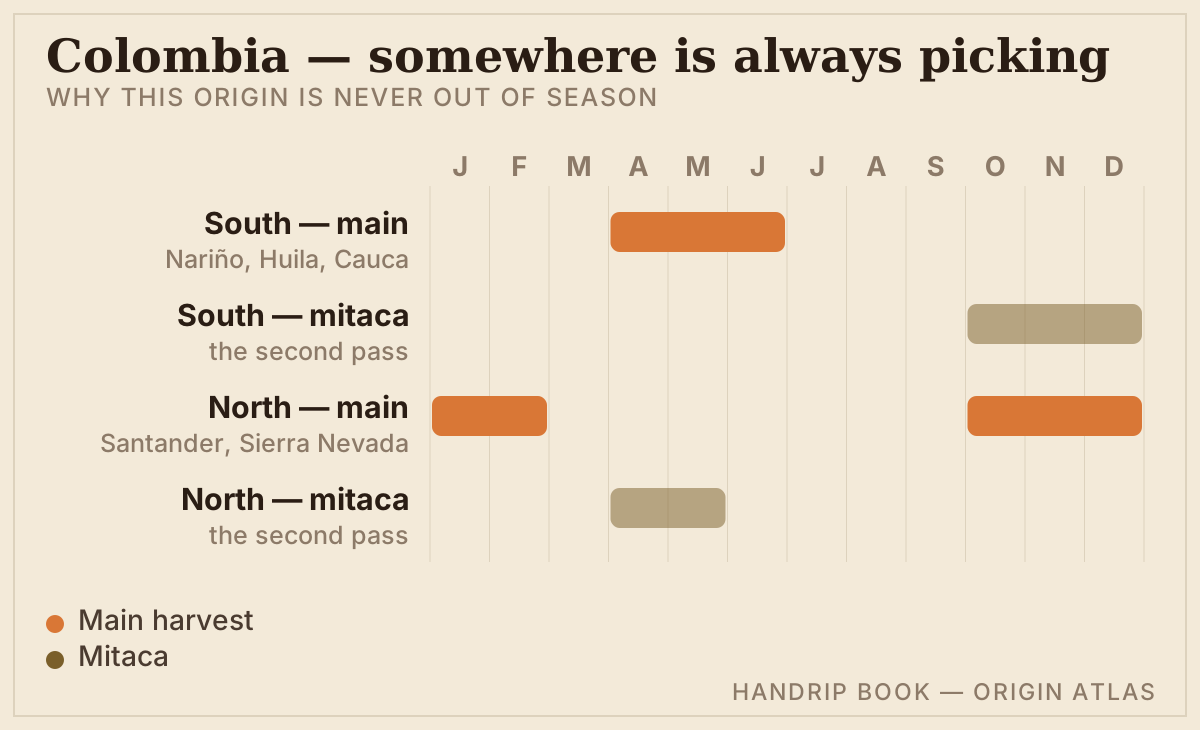
Colombia grows coffee along three separate branches of the Andes, and the branches do not share a calendar. Somewhere in the country, a harvest is starting almost every month of the year. For a roaster that means Colombia is the origin you can always buy fresh; for a drinker it means the word "Colombian" describes a supply situation more than a flavour.
The numbers
| Field | Colombia |
|---|---|
| Growing altitude | 1,200 – 2,100 masl |
| Main harvest, south | April to June, in Nariño, Huila, Cauca |
| Main harvest, north | October to February, in Santander and Sierra Nevada |
| Mitaca | The lighter second harvest, offset about six months |
| Varietals | Caturra, Castillo, Colombia, Typica, Bourbon, Tabi, Pink Bourbon, Geisha |
| Common process | Washed, with fast-growing experimental lots |
| Grading | Supremo and Excelso — by screen size |
| Cup | Caramel, red apple, panela, citrus at altitude |
The land
There are three cordilleras and a coastal massif, and each behaves differently.
- Huila — the largest specialty-producing department, in the south, up the Magdalena valley. High, steep, and the safest bet on a shelf.
- Nariño — further south still, on the Ecuadorian border, and remarkably high. Farms sit at 1,800 to 2,300 masl in a place where the equator makes that survivable. The most acidic Colombian cups come from here.
- Cauca and Tolima — the same southern belt, similar profile, historically harder to access.
- Eje Cafetero — Caldas, Quindío, Risaralda. The classic coffee axis: mid-altitude, balanced, chocolate-and-caramel, and the source of most of the country's reputation for consistency.
- Sierra Nevada de Santa Marta — an isolated coastal massif in the north with its own calendar entirely.
The scale is the thing that is hard to picture. Colombia has well over half a million coffee-growing families, most on two to three hectares, and a national federation — the FNC — that has organised extension, research and export for close to a century. Cenicafé, its research arm, is why the varietal argument below exists.
Caturra, Castillo and the rust argument
Caturra is a natural dwarf mutation of Bourbon, found in Brazil, and for decades the backbone of Colombian quality. It cups beautifully and it has no defence against coffee leaf rust.
Rust arrived seriously in the 1980s and hit hard again around 2008 to 2012. Cenicafé's answer was Castillo, released in 2005 — a Caturra crossed with Timor hybrid, which carries robusta genes and with them rust resistance. The FNC pushed replanting hard, and today Castillo and the older Variedad Colombia are a large share of the national crop.
The argument that followed ran for a decade: does Castillo cup as well? The early consensus was no. The current consensus is that a well-grown, well-processed Castillo at altitude is very good, that the gap was always smaller than the reputation, and that a lot of what was blamed on the varietal was actually a farm that had just been replanted and was still finding its feet.
Where a Colombian bag lists Caturra, Bourbon, Typica, Pink Bourbon or Geisha, the farmer is accepting risk in exchange for cup, and charging accordingly. Where it lists Castillo, that is not a warning.
Process
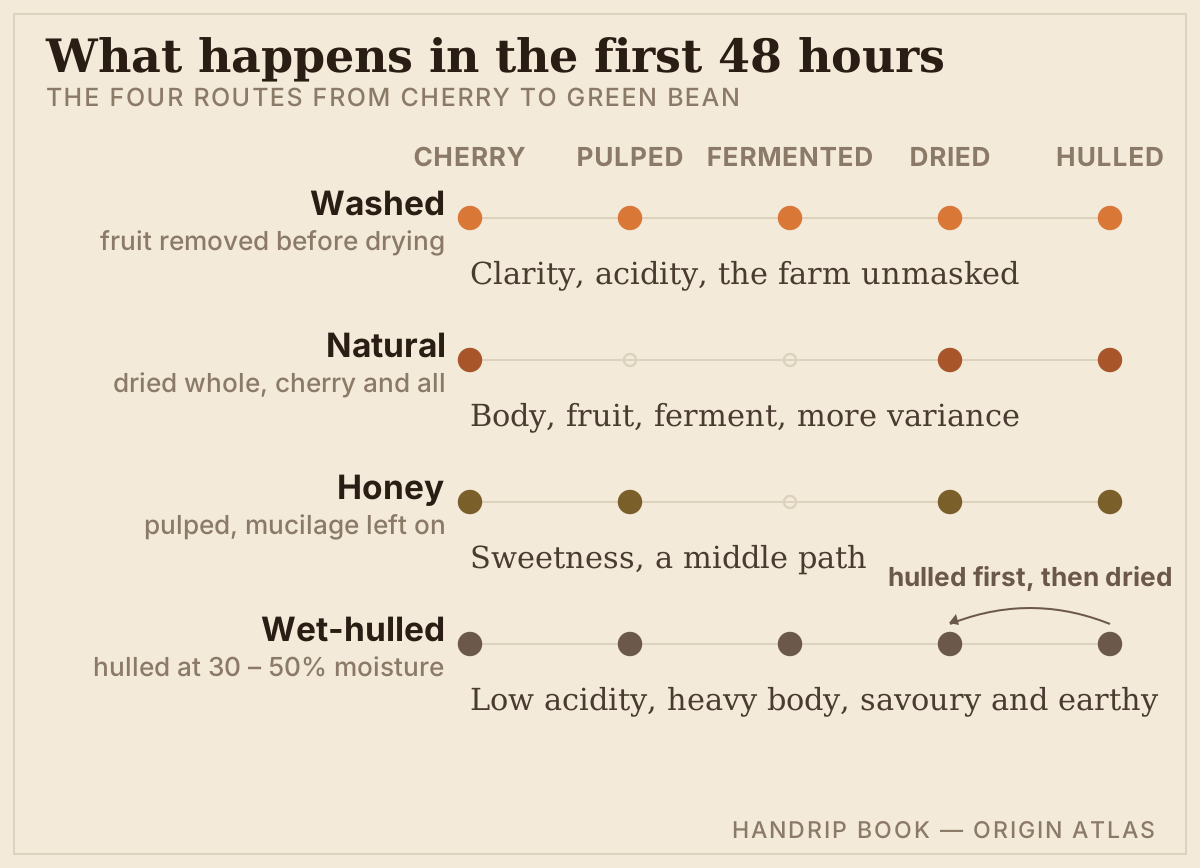
Colombia is washed country, and washed the traditional way: pulped, fermented in tile or concrete tanks for 12 to 24 hours, washed, and dried — often on a rooftop marquesina, a covered parabolic drying tunnel that lets a smallholder dry properly in a rainy climate.
The last decade has added everything else. Colombia is now the most active origin in the world for extended fermentation, anaerobic, thermal shock and inoculated lots. The results range from remarkable to undrinkable, and the price does not always tell you which. If you are new to the origin, learn its washed profile first; you need a baseline before an experimental lot means anything.
Reading the grade
Supremo is screen 17 to 18. Excelso is roughly screen 14 to 16. That is all the words mean — bean size, exactly like Kenya's AA, and exactly as uninformative about quality.
Almost no specialty Colombian coffee is bought on that basis any more. The useful fields on a Colombian bag are the department, the altitude and the farm or association name.
At the brewer
Colombian coffee is the most middle-of-the-road origin in the atlas, which makes it the best one to calibrate a new grinder against.
- Start at the default: 15 g, 1:16, 90 °C, four pours. A washed Huila at a medium-light roast should taste correct there, and if it does not, the equipment is telling you something.
- Nariño and high Huila — treat them closer to Kenya. Hotter, 92 °C, and a finer grind; there is enough acidity to justify it.
- Eje Cafetero, medium roast — cooler, 88 to 89 °C, and a slightly coarser grind. These lots are sweetness-forward and go bitter before they go sour.
- Anaerobic and extended-ferment lots — drop to 86 to 88 °C and coarsen a full step. The aromatics are already loud; extraction only makes them louder.
Next: Panama, and the single varietal that broke the price of coffee.