Panama grows a rounding error of the world's coffee. It is in this atlas for one reason: it is where the market discovered how much a cup of coffee could be worth, and the discovery was an accident.
The numbers
| Field | Panama |
|---|---|
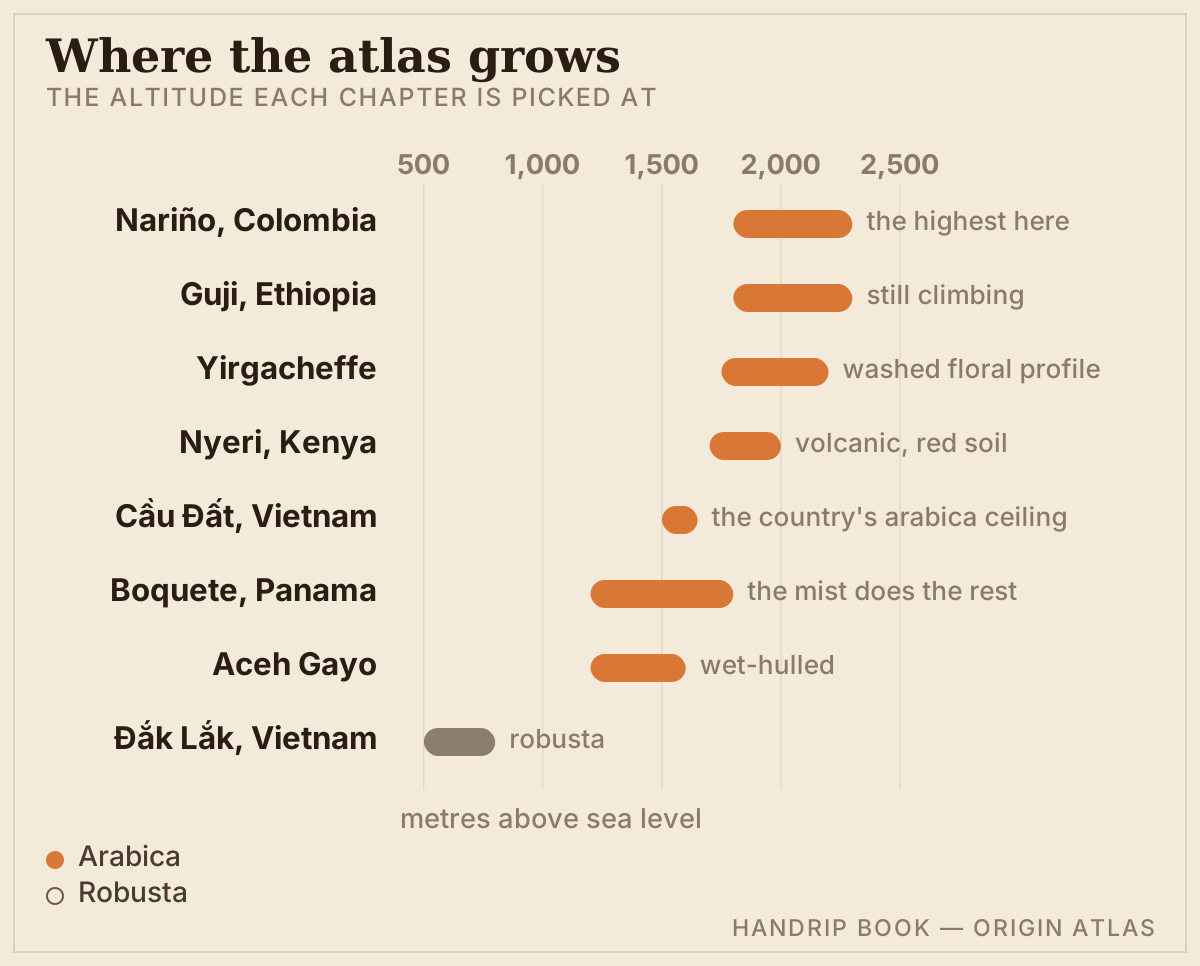
| Growing altitude | 1,300 – 1,900 masl |
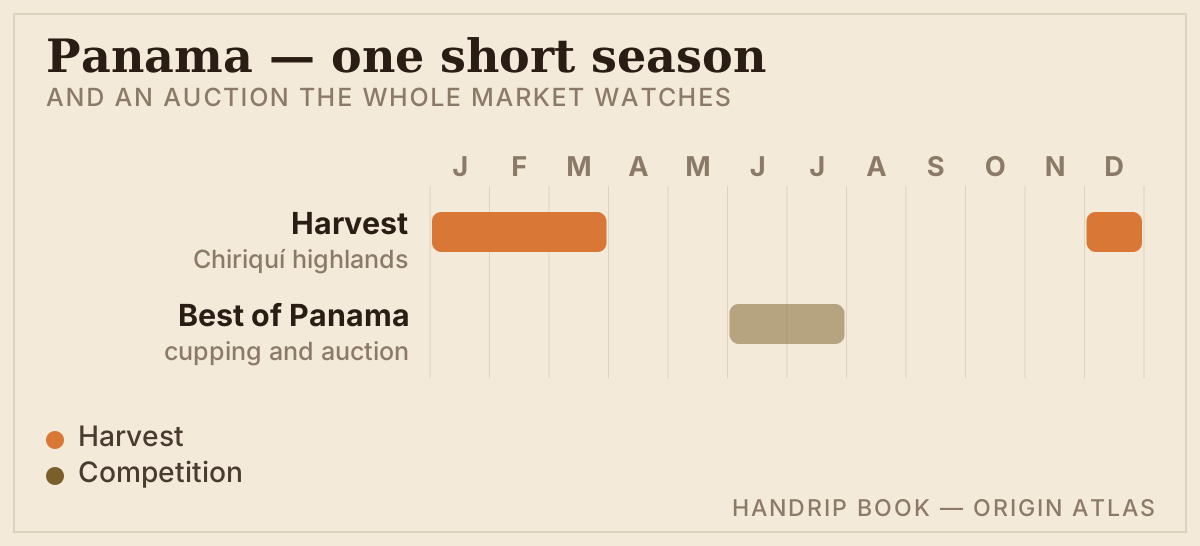
| Harvest | December to March |
| Varietals | Geisha, Caturra, Catuai, Typica, Bourbon, Pacamara |
| Common processes | Washed, natural, honey, anaerobic |
| Sold through | The Best of Panama auction, and direct |
| Cup, Geisha washed | Jasmine, bergamot, peach, lime, tea-like body |
| Cup, Geisha natural | Papaya, mango, tropical fruit, heavier sweetness |
The land
Almost everything worth chasing comes from Chiriquí, the western province against the Costa Rican border, on the slopes of the Barú volcano.
- Boquete — the east side. Cool, high, and defined by the bajareque, a fine wind-driven mist that rolls off the Caribbean and shades the farms for hours a day. Slow ripening without needing extra altitude.
- Volcán and Candela — the west side. Drier, more sun, and increasingly the source of very good competition lots.
- Renacimiento — north-west, higher, and newer to the specialty conversation.
Panamanian farms are large and privately held — the opposite of Ethiopia and Colombia. Names like Hacienda La Esmeralda, Elida Estate, Finca Deborah and Ninety Plus are single estates with their own processing, their own lot separation and their own brands. That structure is why Panama could commercialise a discovery so quickly: one family could decide to plant a varietal, keep it separate, and sell it under their own name.
How Geisha got there
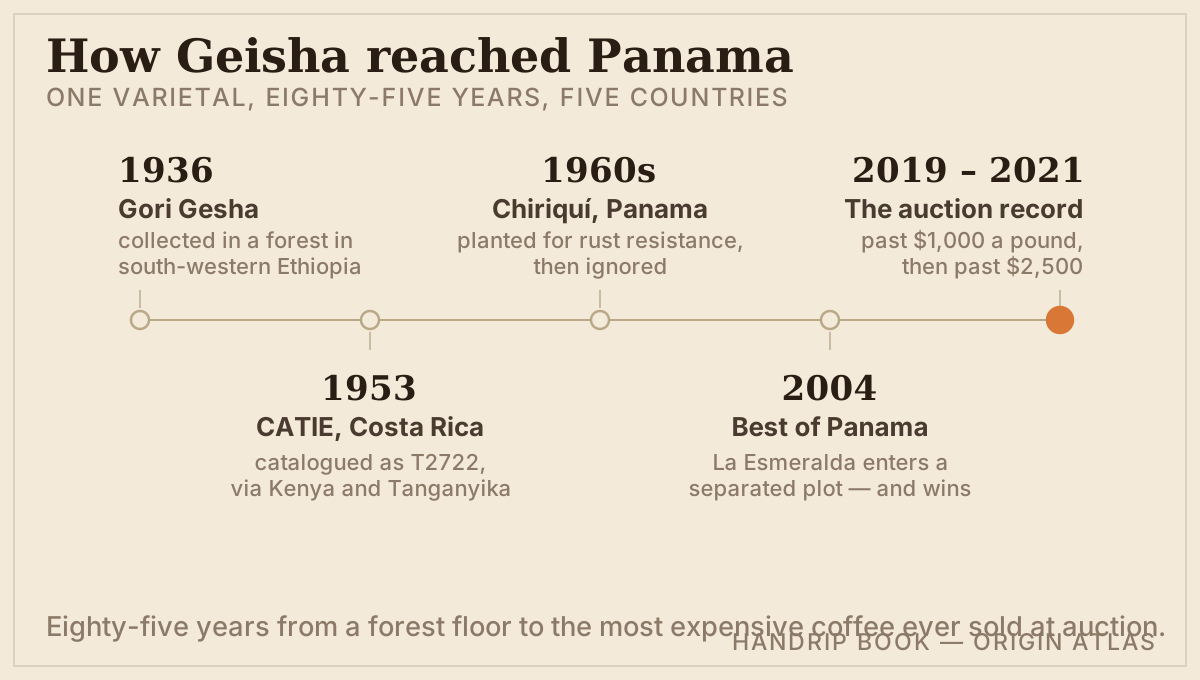
The plant came out of the Gori Gesha forest in south-western Ethiopia in the 1930s, went through Kenya, Tanzania and Costa Rica's CATIE collection, and arrived in Panama in the 1960s as a candidate for rust resistance. It was not especially resistant. It was also tall, spindly, and low-yielding — a bad commercial plant by every measure anyone was applying.
So it sat, largely unused, planted on farm boundaries as a windbreak.
In 2004 the Peterson family at Hacienda La Esmeralda separated out a plot of it on their Jaramillo farm, cupped it apart from everything else, and entered it into the Best of Panama. It won, and it sold for a little over twenty dollars a pound — a multiple of anything green coffee had fetched at auction before.
The line since then goes almost straight up. Panamanian Geisha lots passed a thousand dollars a pound at auction in 2019, and in 2021 an Elida Estate natural Geisha cleared roughly two and a half thousand. These are competition micro-lots of a few dozen kilos, not commercial coffee, and they function as much as a marketing event as a trade — but the price is real, and it has pulled Geisha plantings into Colombia, Costa Rica, China and, lately, Vietnam.
Is it worth it
At auction prices, that is not a question about coffee. At the fifteen-to-thirty-dollars-per-hundred-grams a good non-competition Panamanian Geisha costs in a shop, it is a fair one, and the honest answer is: it tastes like nothing else in this atlas.
A washed Panamanian Geisha is closer to a first-flush Darjeeling than to a coffee. Very light body, jasmine and bergamot on the nose, a lime-and-peach acidity, and a finish that goes on much longer than the weight of the cup suggests it should. People who dislike it usually say it tastes thin, which is not wrong — it is thin. That is the style.
The trap is the word itself. Geisha is a varietal, not a quality grade. Geisha grown at 1,200 masl on tired soil and dried carelessly is an ordinary coffee with an extraordinary price, and there is a great deal of it about now that everyone has planted some. Altitude, farm name and a cup score are still doing the work; the varietal is just the permission slip.
At the brewer
This is the one coffee in the atlas where the brewing advice is do less.
- Ratio — go lighter than usual, 1:16.5 or 1:17. The aromatics are the product; concentration buries them.
- Temperature — 90 to 92 °C for washed lots. Hot enough to extract the florals fully, not so hot that the delicate top end cooks off.
- Grind — a touch coarser than your Ethiopian washed setting, and fewer, gentler pours. Three is often better than four; agitation adds body this coffee does not want.
- Water — if you have ever been going to use low-mineral or bottled brewing water, use it here. Hard water flattens exactly the aromatics you paid for.
- Cup it cool. Panamanian Geisha changes more between 70 °C and room temperature than any other coffee most people own. Drinking it fast is the most common way to waste it.
A cheaper way to learn the same lesson: brew a good washed Yirgacheffe the same way. It is the same genetic neighbourhood, and it costs a twentieth as much.
Next: Indonesia, and a process that overrides everything else on the label.