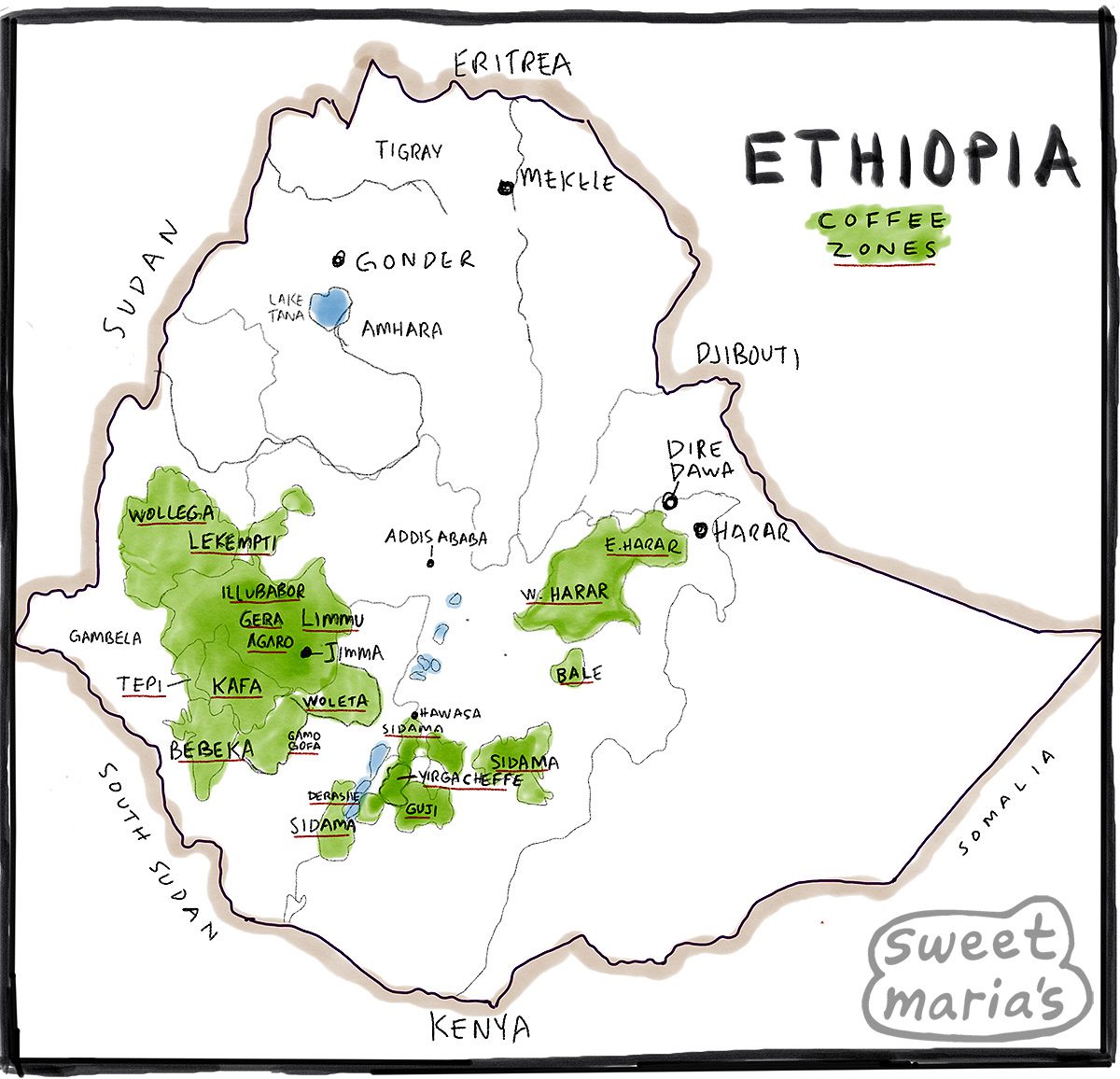
Arabica is an Ethiopian plant. Not figuratively — the species originated in the highland forests of the south-west, and it still grows wild there, in a genetic spread so wide that nobody has finished cataloguing it. Every Bourbon in Brazil, every Caturra in Colombia and every Geisha in Panama is a narrow selection out of what Ethiopia has lying around in the undergrowth.
That is the whole story of Ethiopian coffee, and it explains the two things newcomers find strange: why it tastes unlike other origins, and why the varietal line on the bag is so unhelpful.
The numbers
| Field | Ethiopia |
|---|---|
| Growing altitude | 1,500 – 2,300 masl |
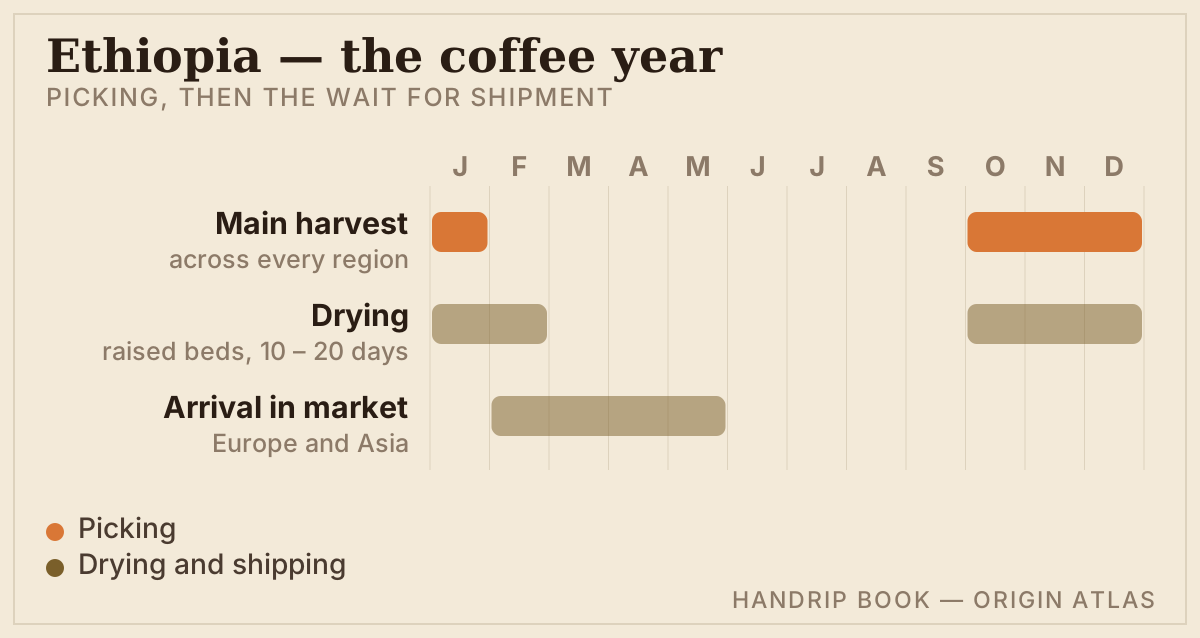
| Main harvest | October to January |
| Arrival in market | February to May |
| Varietals | Indigenous landraces, plus JARC selections |
| Common processes | Washed and natural, both traditional |
| Grading | G1 to G5, by defect count |
| Cup, washed | Jasmine, bergamot, lemon, black tea |
| Cup, natural | Blueberry, strawberry, tropical fruit |
The land
Four names cover most of what reaches a specialty shelf.
- Yirgacheffe — a small, very high district inside Gedeo, 1,750 to 2,200 masl. The floral-citrus washed profile that most people mean when they say "Ethiopian coffee" comes from here.
- Sidama — larger and more varied, wrapping around Yirgacheffe. Naturals from Sidama built the blueberry reputation.
- Guji — south of Sidama, and the region that has gained the most ground in the last decade. Some of the highest farms in the country, up to 2,300 masl, and cups that lean stone fruit and floral at once.
- Limu, Jimma and Kaffa — the west and south-west. Lower, wetter, more forest-grown, historically sold as commodity, increasingly not.
Farms are small. The typical Ethiopian coffee grower has under a hectare of trees mixed in with food crops, and delivers cherry to a nearby washing station. What you buy is almost always a station lot — the day's cherry from several hundred neighbouring smallholders, processed together. That is why traceability in Ethiopia usually stops at a station name rather than a farmer's name, and why a station's reputation is worth as much as a farm's is elsewhere.
Why the varietal line says heirloom
Because nobody knows. There are thousands of distinct wild and semi-wild populations, most unnamed, growing side by side in the same plots. "Heirloom" is the industry's shorthand for an unsurveyed mix of local landraces.
Where it does get specific, you will see:
- Kurume, Dega, Wolisho — local Gedeo names for tree types farmers themselves distinguish. Kurume is the small-cherried one associated with the most intense florals.
- 74110, 74112, 74158, 74165 — selections released by the Jimma Agricultural Research Centre, numbered by the year of collection. These are real, named cultivars, disease-resistant, and increasingly common on labels. A five-digit number on an Ethiopian bag is a varietal, not a lot code.
Washed or natural
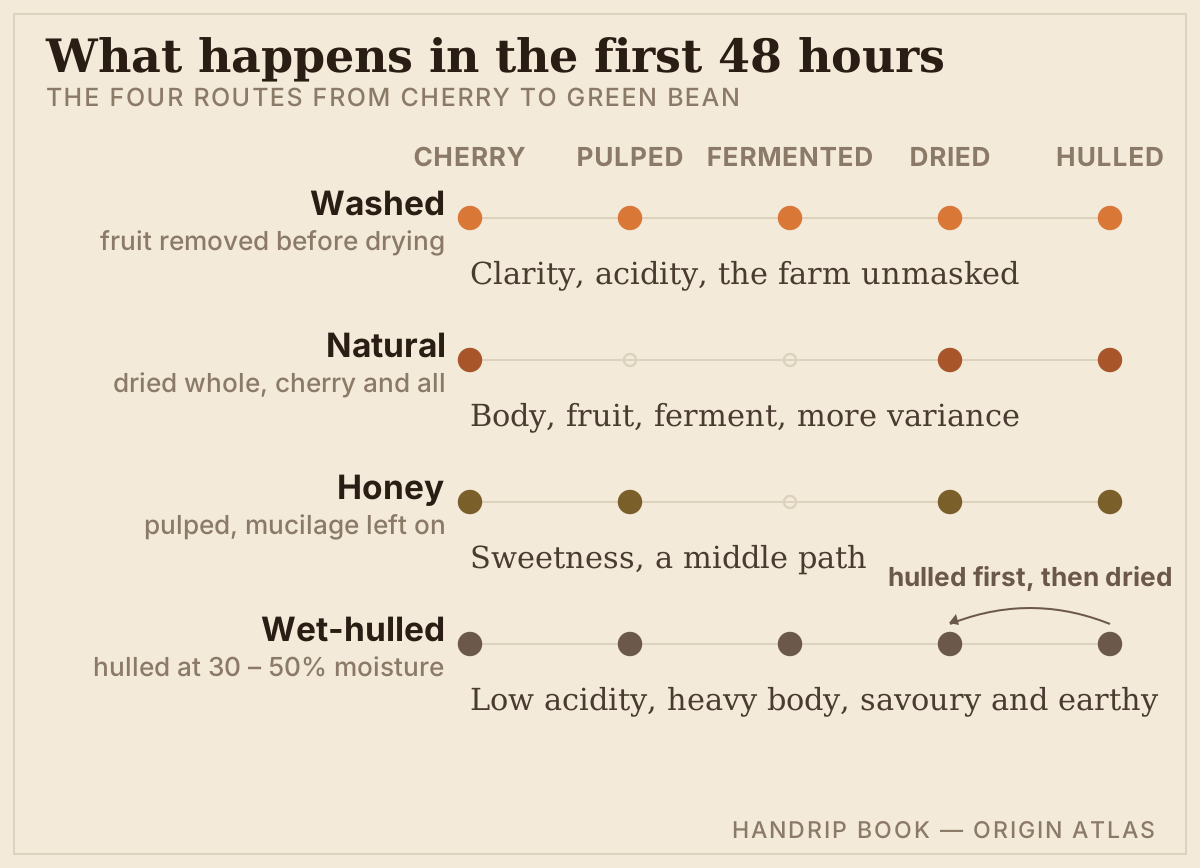
Ethiopia is one of the few origins where both processes are genuinely traditional, and the two produce cups so different that a blind taster would not place them in the same country.
Washed Ethiopian coffee is the clearest demonstration of what washing is for. Strip the fruit away and what remains is aromatic and light — jasmine, bergamot, lemon peel, a black-tea body that finishes dry and clean.
Natural Ethiopian coffee is the opposite argument. The cherry dries on the seed for two to three weeks on raised beds, and the cup arrives thick with berry and ferment. Quality here is entirely a function of drying discipline: beds turned often enough, coffee pulled into shade at midday, layers kept thin. A sloppy natural is not fruity, it is fermented, and the distance between the two is a few hot afternoons.
Reading the grade
Ethiopian grades run G1 to G5 and count defects in a 300 g sample. G1 allows the fewest. It says nothing about bean size, altitude or cup score — a G1 is a clean coffee, and clean is a floor, not a ceiling.
You will see G1 on nearly every specialty Ethiopian bag, which makes it nearly useless as a discriminator. The station name and the region are doing the real work.
At the brewer
Ethiopian coffee is light-roasted, dense and aromatic, and it is the origin most often brewed too conservatively.
- Washed lots — go finer than you think and keep the water hot, 91 to 93 °C. The florals live at the edge of full extraction and an under-extracted Yirgacheffe just tastes thin and sour. A 1:16 at 15 g is a fine starting point; if the cup is hollow, tighten the grind before you touch anything else.
- Naturals — the reverse. Ferment sugars come out early and fast, so back the temperature off to 88 to 90 °C and open the grind a step. Four pours rather than three keeps the bed from compacting under the extra fines these lots tend to carry.
- Both — rest the bag. Ethiopian light roasts are often still degassing at day five and taste noticeably better at day ten.
If you keep one thing: the region and the station tell you more than the varietal, and the process tells you more than either. Next chapter, Kenya, is where the varietal finally starts to matter.