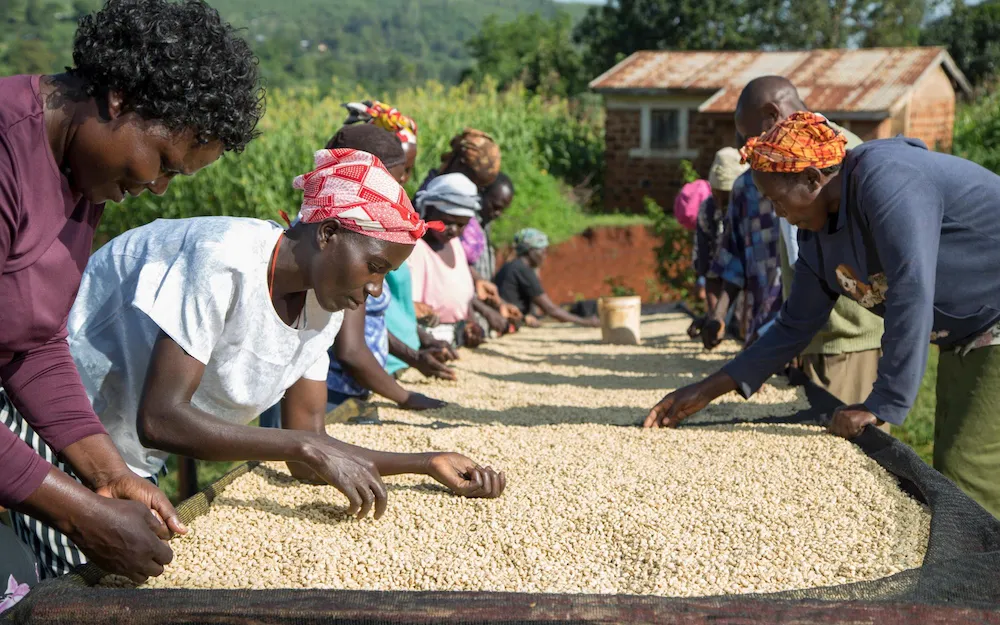
Kenya produces a fraction of what Brazil or Vietnam does, and has an influence out of all proportion to the volume. Ask anyone in specialty to name a cup they could identify blind and Kenya comes up first: blackcurrant, tomato, grapefruit, and an acidity so structural that it reads as savoury as often as it reads as fruit.
That profile is the product of three deliberate things — a varietal programme, a processing protocol and a marketing system — layered on very good ground.
The numbers
| Field | Kenya |
|---|---|
| Growing altitude | 1,400 – 2,100 masl |
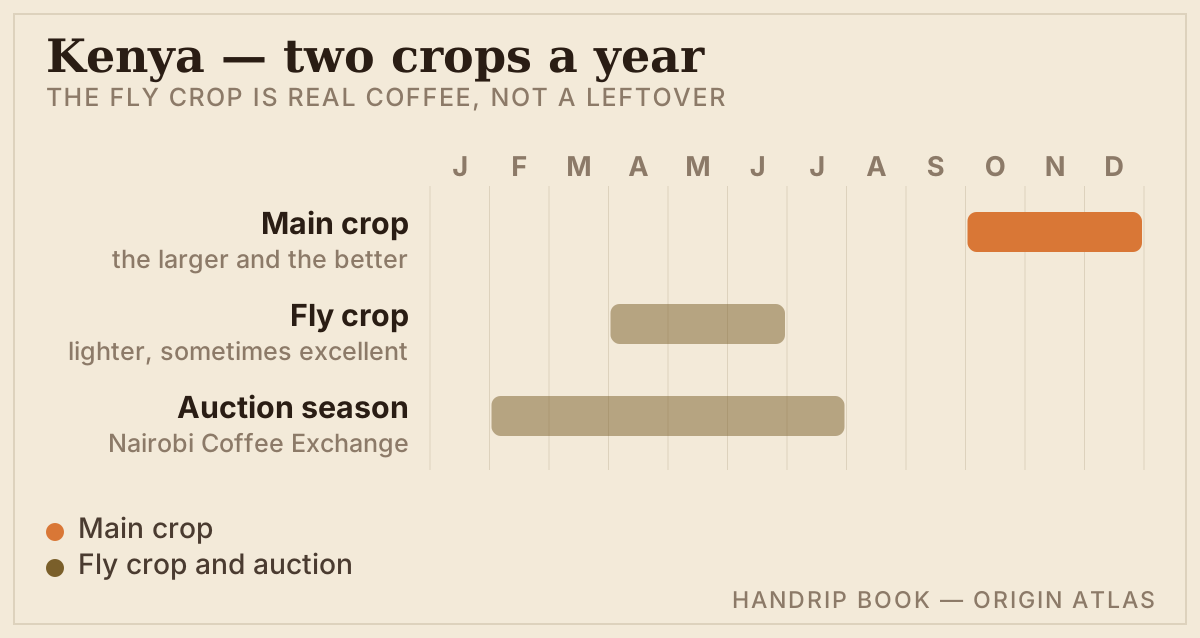
| Main harvest | October to December |
| Fly crop | April to June |
| Varietals | SL28, SL34, Ruiru 11, Batian, K7 |
| Common process | Washed, with a soak |
| Grading | AA, AB, PB, C, E, TT, T — by screen size |
| Cup | Blackcurrant, tomato, grapefruit, brown sugar |
The land
The good ground is volcanic, red, high, and clustered around Mount Kenya and the Aberdares.
- Nyeri — the most decorated county. Deep red volcanic soil, farms at 1,700 to 2,000 masl, and the densest concentration of famous factories.
- Kirinyaga — on the other flank of the mountain, and Nyeri's equal on cup scores in most years.
- Muranga, Embu, Kiambu — the rest of the central belt, ranging from excellent to ordinary depending on how a factory is run.
The unit you buy from is a factory, which in Kenyan usage means a washing station, not a mill. Factories belong to farmers' cooperative societies; a society may run half a dozen. Members deliver cherry, the factory processes and dries it, and the lot is sold under the factory's name. Kenyan traceability therefore lands in the same place as Ethiopia's — at a station serving hundreds of smallholders — but the factories are individually famous in a way Ethiopian stations mostly are not.
SL28 and SL34
In the 1930s, a colonial outfit called Scott Agricultural Laboratories screened varietals for the Kenyan highlands, looking for drought tolerance and yield. Their selections were numbered. Two of them — SL28, out of a Tanganyika drought-resistant population, and SL34, from a French Mission Bourbon planting near Nairobi — turned out to produce an extraordinary cup, which was not what they were selected for.
SL28 in particular is the source of the blackcurrant. It is also low-yielding, ages badly and has no resistance to coffee berry disease, which is the whole tension in Kenyan coffee today: the trees that made the reputation are the trees that are hardest to keep alive.
The answers to that are Ruiru 11 (1985, disease-resistant, historically a weaker cup) and Batian (2010, disease-resistant, and much closer to SL quality). A bag listing SL28 and SL34 only is telling you the farmer took the harder road.
The wash, and the soak
Kenyan processing is its own protocol and it is unusually specific.
- Cherry is pulped the day it is picked, and separated by density in the process.
- It ferments under water, typically overnight.
- It is washed, then fermented a second time, then washed again in grading channels.
- Then the distinctive step: the parchment soaks in clean water, often 12 to 24 hours, before it goes to the drying tables.
Nobody fully agrees on what the soak does. The practical results are consistent, though — an exceptionally clean cup, and that bright, almost juicy acidity. Drying then takes one to three weeks on raised beds under shade nets.
Reading the grade
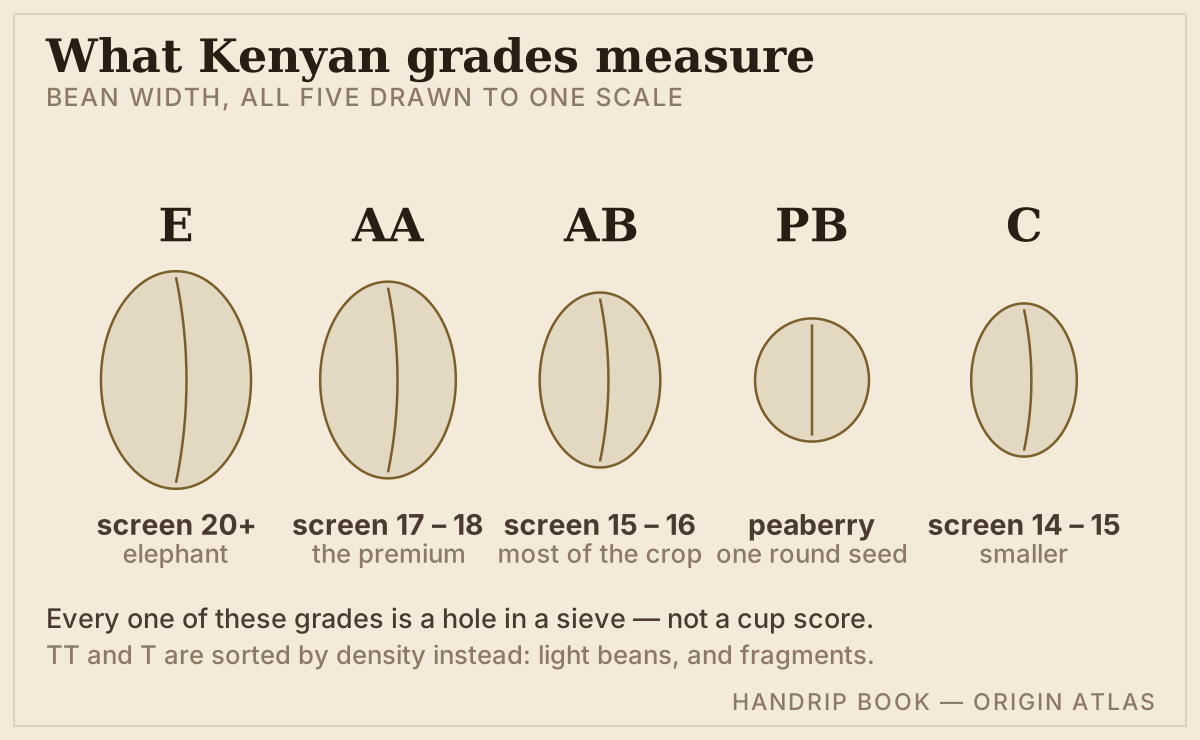
This is the point most worth internalising, and the pillar chapter makes it in general terms: Kenyan grades are screen sizes.
| Grade | What it is |
|---|---|
| AA | Screen 17 to 18, roughly 7.2 mm and up |
| AB | Screen 15 to 16 — by volume, the bulk of the crop |
| PB | Peaberry, the single round seed |
| C, E, TT, T | Smaller, larger-and-lighter, and the fragments |
AA sells at a premium because big beans have historically cup well and because the auction rewards them, not because the grade certifies anything. Plenty of AB lots out-score the AA from the same factory on the same day. If you have only ever bought AA, buying the AB from a factory you already trust is the cheapest experiment in Kenyan coffee.
Most lots still move through the Nairobi Coffee Exchange auction, which is why Kenyan bags cite an auction outturn number, and why direct relationships are harder to build here than in Colombia or Panama.
At the brewer
Kenyan coffee is dense, acid-forward and forgiving of heat.
- Brew it hot — 92 to 94 °C. Kenyan acidity does not need protecting; the risk is a thin, sharp under-extraction, not a burnt one.
- Grind on the finer side and accept a longer contact time. Three and a half to four minutes on a V60 at 15 g is normal, not a stall.
- A 1:15 ratio suits it better than 1:16. The extra concentration gives the blackcurrant something to sit on and rounds out what can otherwise read as aggressive.
- If the cup tastes like tomato in a way you do not enjoy, that is usually under-development in the roast rather than anything you can fix in the brewer.
Next: Colombia, where the number of farms goes from hundreds to hundreds of thousands.