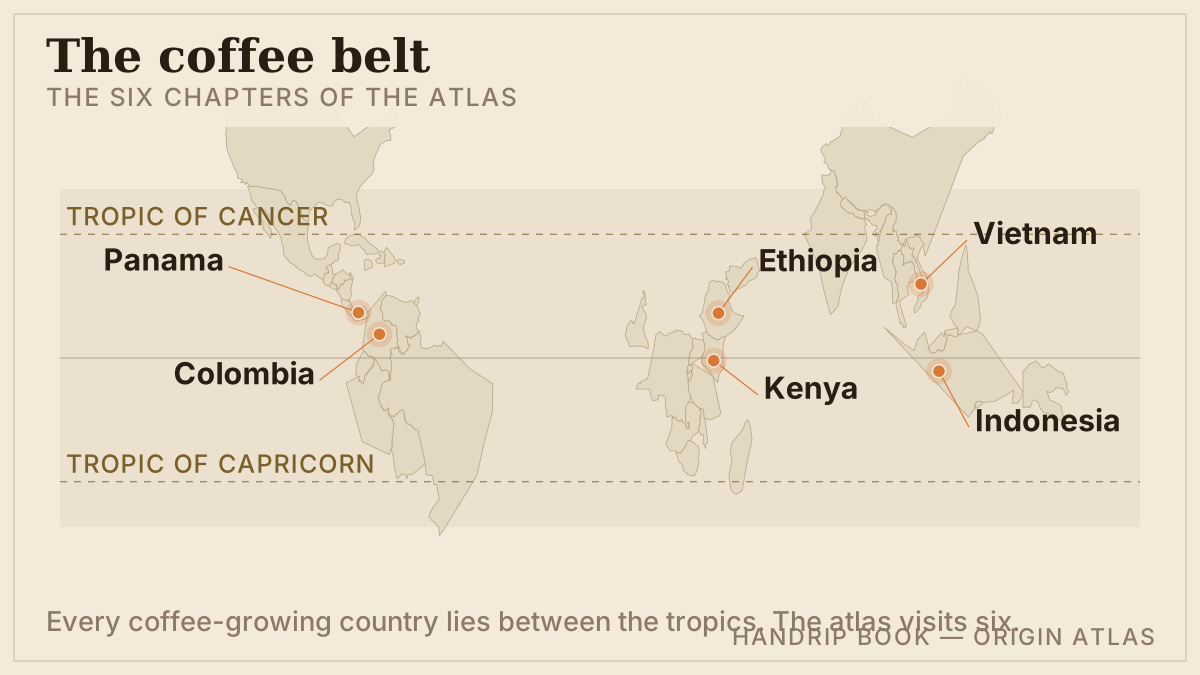
A bag of specialty coffee is a very short document. Six or seven lines, most of them proper nouns, and no explanation of any of them. This is the key to that document — and the index to the country chapters that follow.
Four of those lines do real work. Everything else is branding.
Altitude is a range, and the range is the point
You will see 1,700 – 2,100 masl far more often than a single number, and the two ends are not sloppiness. A farm is a hillside. The bottom of it and the top of it are different growing environments, and a lot that blends them is honestly describing a spread.
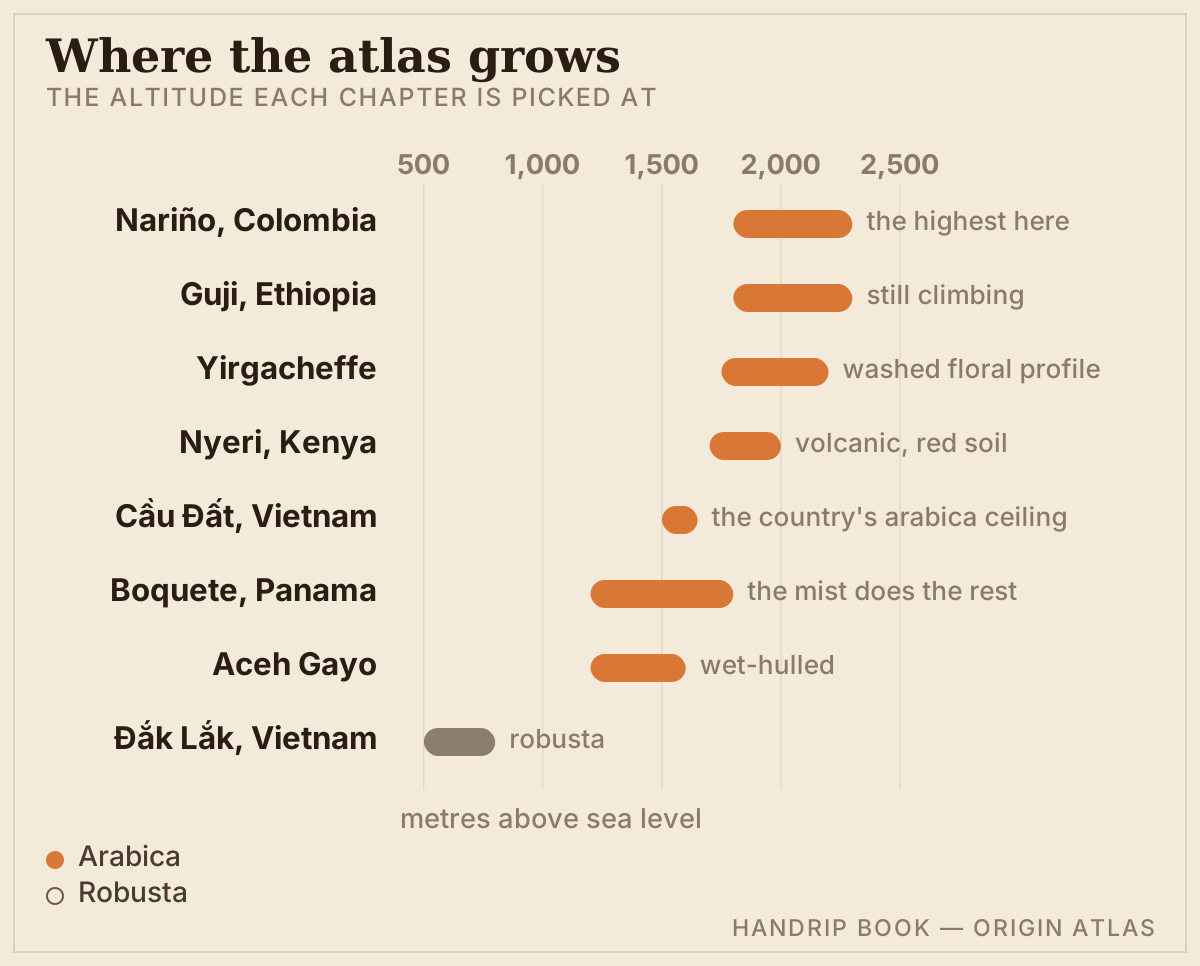
What altitude buys is slowness. Higher ground means colder nights, which means the cherry takes longer to ripen. A bean that spent nine months filling instead of six is denser, holds more of the acids and sugars that survive roasting, and — this is the part you feel — resists heat differently in the roaster and in the brewer.
Density is why the same grind setting behaves differently across two bags. A 2,000 masl Kenyan and a 1,200 masl Sumatran ground at the same number are not the same particle size in any way that matters.
Read the bottom of the range when you are guessing at grind. The softest beans in the bag are the ones that will over-extract first.
Varietal is the plant, not the flavour
Varietal tells you what was planted, which sets a ceiling and a tendency, not a taste. It is the single most over-read word on a bag.
A few that recur across the atlas:
- Bourbon and Typica — the two old-world parents. Sweet, rounded, low-yielding, and vulnerable to almost everything.
- SL28 and SL34 — Kenyan selections from the 1930s, bred for drought, accidentally bred for blackcurrant.
- Caturra and Catimor — a Bourbon dwarf, and its rust-resistant cross with Timor hybrid. Catimor is why a great deal of Asian and Central American arabica exists at all, and it has a reputation it has largely outgrown.
- Geisha — an Ethiopian landrace that went to Panama and turned into a market of its own. See the Panama chapter for what it costs.
- Heirloom — not a varietal. It is what the industry writes when the answer is dozens of wild Ethiopian landraces we did not survey.
Process is what happened in the first 48 hours
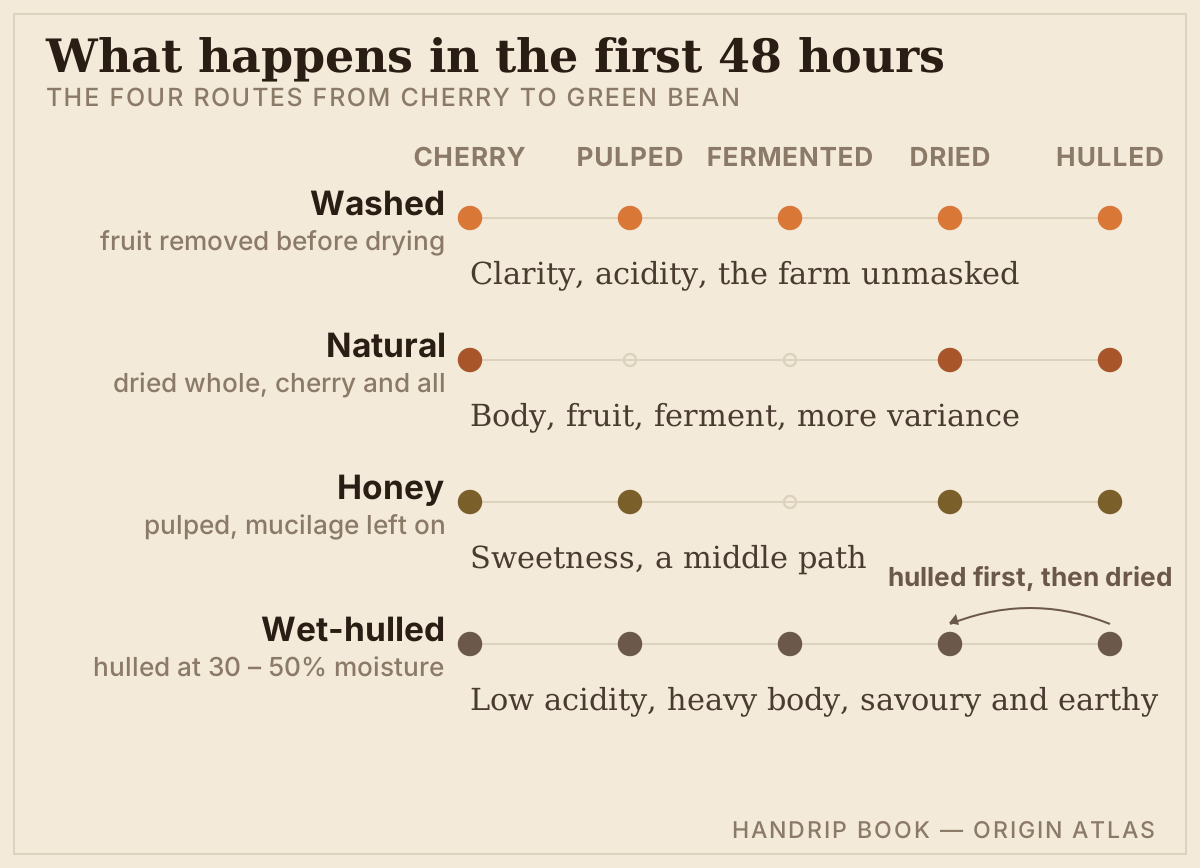
After picking, the cherry has to come off the seed. How that is done changes the cup more than the varietal does.
| Process | What happens | What it tends to give |
|---|---|---|
| Washed | Pulped, fermented, the mucilage scrubbed off, then dried | Clarity, higher perceived acidity, the origin unmasked |
| Natural | Dried whole, cherry and all | Body, fruit, ferment, more variance lot to lot |
| Honey / pulped natural | Pulped, but some mucilage left on to dry | Sweetness, a middle path |
| Wet-hulled (giling basah) | Parchment stripped at high moisture, then dried | Low acidity, heavy body, savoury and earthy |
| Anaerobic | Fermented sealed, without oxygen | Intensity, distinctive ferment character, wide quality spread |
Washed coffee shows you the farm. Natural and anaerobic coffee show you the processing decision. Neither is better; they answer different questions.
Grade means a different thing in every country
This is the one that misleads people most, because the word looks universal and is not. A grade is whatever the exporting country's standard measures — and the countries do not measure the same thing.
| Origin | Grade you will see | What it actually measures |
|---|---|---|
| Ethiopia | G1, G2 | Defect count per 300 g sample |
| Kenya | AA, AB, PB, C | Screen size of the bean, nothing else |
| Colombia | Supremo, Excelso | Screen size |
| Brazil | NY 2 / 3, plus a cup grade | Defect count and a cup score, together |
| Indonesia | G1, G2, G3 | Defect count |
| Vietnam | Screen 16/18, or a Fine Robusta score | Size, or a cup protocol score |
So a Kenyan AA is a big bean and a promise of nothing. An Ethiopian G1 is a clean bean and a promise of nothing about size. Reading AA as the best grade is the most common misreading in the whole document, and it is worth un-learning before you pay for it.
The chapters
Each one covers the same ground in the same order: the land, the plants, the processing, and what to do differently at the brewer.
| Chapter | Why it is in the atlas |
|---|---|
| Ethiopia | Where the species is from, and the only place still growing it wild |
| Kenya | Acidity organised into a national style, and a grading system worth understanding |
| Colombia | Two harvests a year, half a million farms, and the rust-resistance argument |
| Panama | One varietal, one auction, and the ceiling of what coffee can cost |
| Indonesia | Wet-hulling — the one process that makes a region unmistakable |
| Vietnam | The second-largest producer on earth, and the arabica almost nobody exported |
What to do with all this
Not much, immediately. That is the honest answer. Origin information does not tell you a recipe — it tells you which direction to move when the first cup is wrong.
Roughly:
- High altitude, washed, light roast — grind finer than feels right, water at the top of your range.
- Natural or anaerobic — go coarser and cooler; the ferment sugars extract fast and turn heavy.
- Wet-hulled — the cup has no acidity to protect, so brew it hot and full; you are chasing body.
The rest of the atlas is the long version of that paragraph.