Vietnam is the second-largest coffee producer in the world and the largest producer of robusta by a wide margin. For most of the last three decades that fact travelled without any others attached: Vietnam meant volume, robusta and price pressure, and the specialty conversation went on elsewhere.
That framing was never complete, and it is now badly out of date. Two things were always true underneath it — there is real arabica ground here, and there is a domestic coffee culture large enough to absorb the good lots without ever putting them on a boat.
The numbers
| Field | Vietnam |
|---|---|
| Robusta share of the crop | Roughly 95 percent |
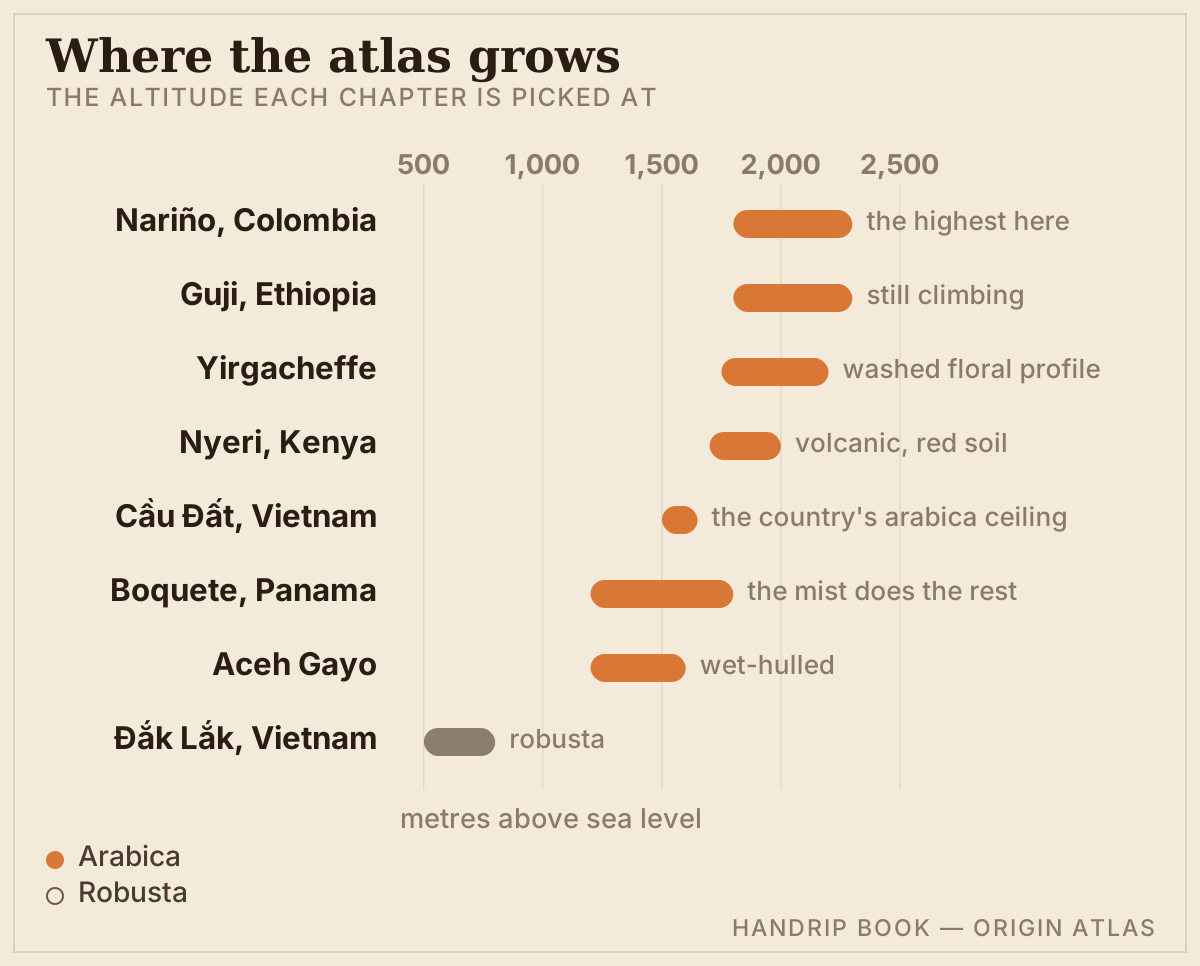
| Robusta altitude | 500 – 800 masl, in the Central Highlands |
| Arabica altitude | 1,000 – 1,650 masl |
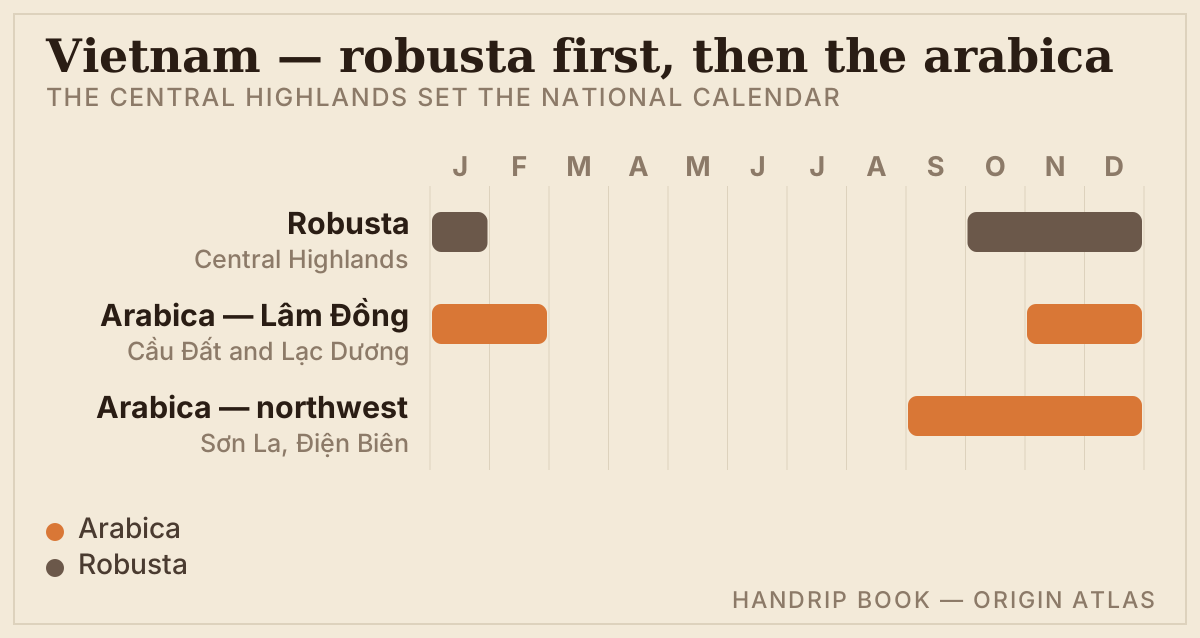
| Harvest, Central Highlands | October to January |
| Harvest, Lam Dong arabica | November to February |
| Arabica varietals | Catimor, with Bourbon, Typica, Moka, and newer trial plantings |

| Export grading | Screen size and defect count, or a cup score for specialty |
The land
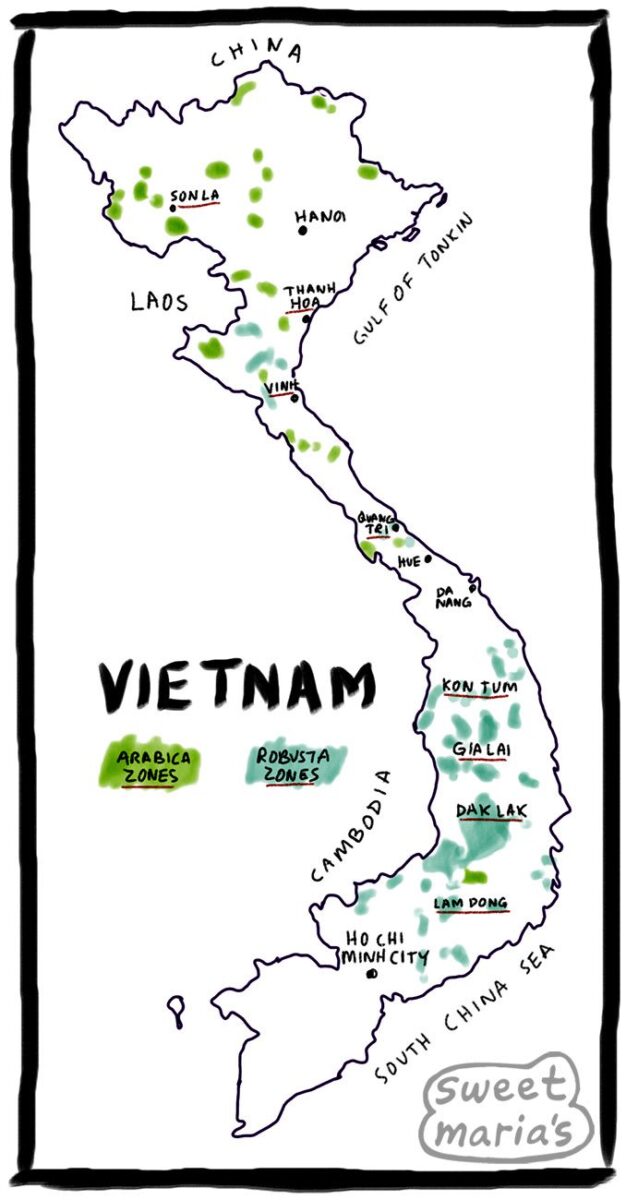
The Central Highlands — Dak Lak, Gia Lai, Dak Nong, Kon Tum — is the robusta engine. Basalt soil, a hard dry season, and farms built around Buon Ma Thuot. This is the ground that made Vietnam a top-two producer inside a generation.
Arabica lives in three other places.
- Lam Dong — Cau Dat, on the plateau south-east of Da Lat, sitting at 1,500 to 1,650 masl. The French planted here in the 1920s, and it remains the most established arabica ground in the country. Lac Duong and the Langbiang slopes are the newer high-altitude expansion.
- The northwest — Son La and Dien Bien, particularly Muong Ang and Mai Son, from about 900 to 1,300 masl. A real winter here, and a cleaner, more citric profile than the south.
- Quang Tri — Khe Sanh, in Huong Hoa district. Lower and hotter than the others, and mostly Catimor.
Catimor, and what else is out there
Vietnamese arabica is overwhelmingly Catimor — the Caturra crossed with Timor hybrid that shows up in Indonesia as Ateng and in Colombia as the parent of Castillo. It was planted for the same reason everywhere: it resists leaf rust and it yields.
Catimor has a poor reputation that it has partly earned and largely outgrown. Grown at 1,500 masl, picked ripe and processed carefully, Cau Dat Catimor is a clean, cocoa-and-stone-fruit coffee that has no trouble standing next to a mid-altitude Central American. Grown at 900 masl, strip-picked, and dried on a tarp beside a road, it is the flat, woody cup that built the reputation. The varietal was never the variable.
Alongside it: Bourbon and Moka survive around Cau Dat as a French colonial inheritance, in small quantities and at a premium. Typica persists in older plots. And since roughly 2018, farms in Lam Dong have been putting in Geisha, SL34, Pacamara and Java — trial plantings, mostly, but the first harvests are already appearing on the domestic market.
Fine robusta is a real category
The most interesting development in Vietnamese coffee is not the arabica.
Fine robusta is a defined thing — there is a cupping protocol for it, distinct from the arabica one, and coffees are scored against it. What it requires is what commodity robusta has never been given: ripe selective picking, controlled fermentation, proper drying, and a farm that is being paid enough to bother.
Done that way, robusta stops tasting like the flat, rubbery baseline everyone has in their head. It comes out heavy-bodied, dark-chocolate, nutty, sometimes with a dried-fruit sweetness, and with about twice the caffeine of arabica. It is also, uniquely among the coffees in this atlas, exactly the right raw material for the drink most of the country actually drinks — phin-brewed, with condensed milk, over ice. That was never a compromise. Robusta's body and bitterness are what stand up to sweetened milk; a delicate washed arabica would disappear.
What is changing
Two structural things, both recent.
The first is traceability down to the farmer. Vietnamese coffee moved through collectors and exporters in undifferentiated volume for decades, and the farm name simply was not recorded. Producer-named lots are now normal on the specialty market, which is why you will increasingly see two coffees from the same district, the same altitude and the same varietal that are genuinely different coffees — because they are different farms.
The second is that the domestic market got there first. Vietnam is unusual among producing countries in drinking a large share of its own good coffee. Roasters in Ho Chi Minh City, Hanoi and Da Lat compete for the same micro-lots an exporter would want, and often win. If you want the best of what this country grows, the reliable way to get it is still to be standing in it.
At the brewer
- Cau Dat washed arabica — treat it as a balanced medium. 15 g at 1:16, 90 to 91 °C, four pours. It has moderate acidity and good sweetness; pushing the temperature higher tends to bring out a dry, woody finish.
- Northwest lots from Son La or Dien Bien — brighter and thinner. Go up to 92 °C and finer, closer to how you would treat a Colombian from Narino.
- Naturals and anaerobics — Vietnam produces a lot of these and they run intense. 87 to 89 °C, a step coarser, and a lighter ratio at 1:16.5.
- Fine robusta on a filter — brew it cooler than instinct says, 88 to 90 °C, at 1:15, and coarser than arabica. Robusta extracts faster and its bitterness arrives early; the goal is body without the hard edge. Give it a longer bloom, 45 seconds, because it degasses hard.
- Phin — a different instrument with different rules. Coarser than filter, a full pre-infusion, and no attempt to hurry the drip. That is a chapter of its own.
Back to the index: The Origin Atlas.