Every other chapter in this atlas is a story about land and plants. This one is a story about a machine, used at the wrong moisture content, for a very good reason.
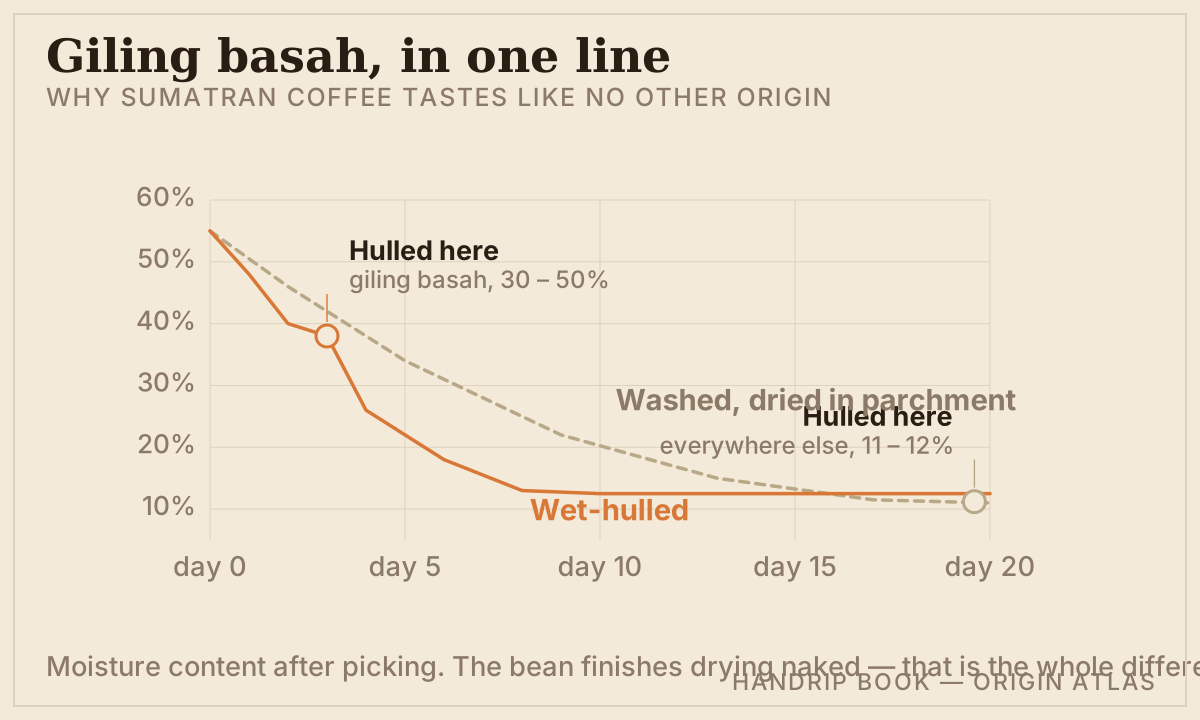
Indonesian coffee — Sumatran especially — is instantly identifiable, and people tend to attribute that to the soil or the tropics. It is not. It is giling basah, and if you moved the process to Kenya, Kenyan coffee would taste like this too.
The numbers
| Field | Indonesia |
|---|---|
| Growing altitude | 1,100 – 1,600 masl |
| Harvest, Sumatra | September to December, with scattered pickings year-round |
| Varietals | Ateng, Tim Tim, Bergendal, Sidikalang, Jember, S-795 |
| Signature process | Giling basah, or wet hulling |
| Grading | G1 to G3, by defect count |
| Cup | Cedar, tobacco, earth, dark chocolate, herbal, very low acidity |
| Body | Heavy, syrupy, the origin's whole selling point |
The land
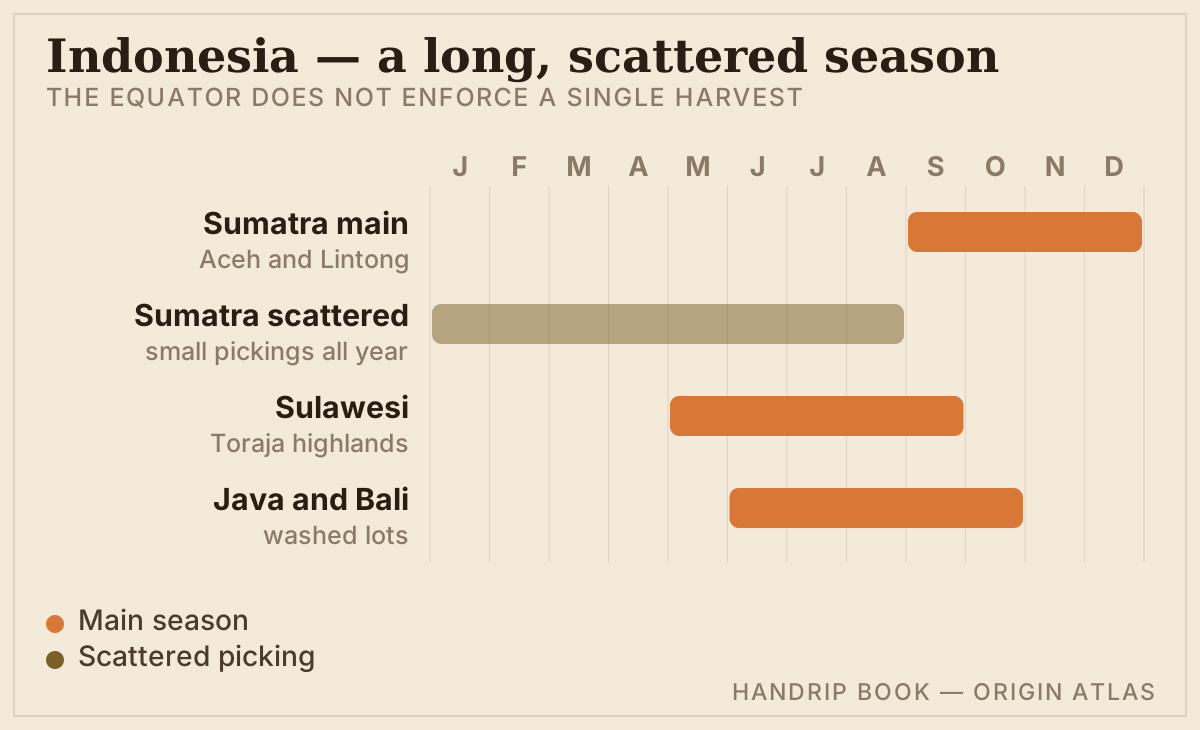
Coffee grows across the archipelago, and four islands matter on a specialty shelf.
- Sumatra — the volume and the reputation. Aceh in the far north, around Lake Tawar, produces Gayo coffee; North Sumatra, around Lake Toba, produces Lintong and Mandheling. Both are highland, volcanic and smallholder-farmed.
- Java — the oldest plantation coffee in the world outside Africa and Arabia, and the reason "java" became a synonym for coffee. Government-run estates on the Ijen plateau still produce washed lots that taste nothing like Sumatra.
- Sulawesi — the Toraja highlands. Cleaner and more restrained than Sumatra, sometimes wet-hulled and sometimes washed.
- Flores and Bali — smaller, mostly washed, and worth trying precisely because they show what Indonesian coffee tastes like without the wet hulling.
Plot sizes are tiny — often under a hectare — and the supply chain runs through village collectors who buy wet parchment daily. That chain is the practical reason giling basah exists.
What giling basah actually is
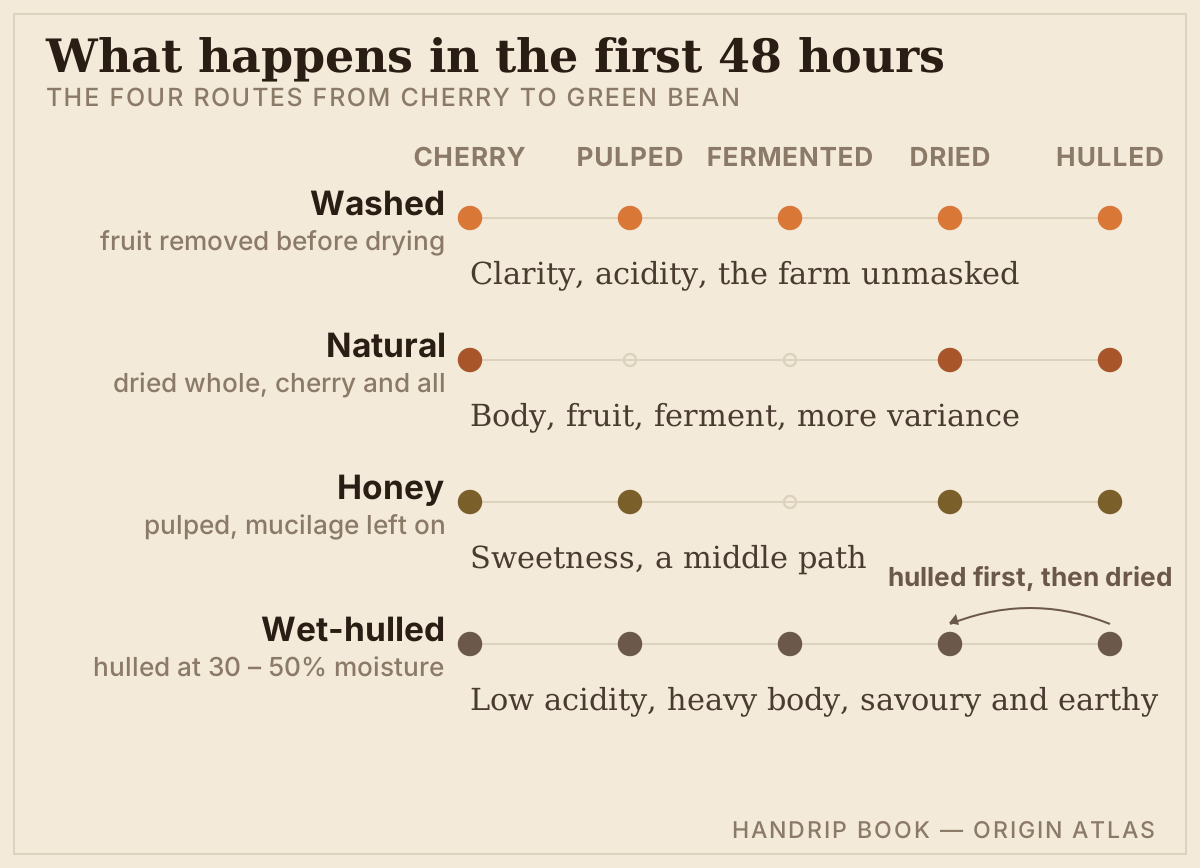
Everywhere else, coffee is dried in parchment down to 10 to 12 percent moisture, rested, and only then hulled. In Sumatra:
- The farmer pulps the cherry the evening it is picked, often with a hand mill.
- It ferments overnight in a bucket or sack, then gets washed by hand.
- It dries for a day or so, to somewhere between 30 and 50 percent moisture — nowhere near stable.
- At that point it is sold to a collector, who hulls it wet. The parchment comes off a soft, swollen, still-damp bean.
- The naked green bean, now a distinctive dark blue-green, is dried the rest of the way in the open.
Steps three and four are the whole story. Hulling at high moisture damages the bean's surface, exposes it to the air and to microbial activity for the remainder of drying, and produces the flavour compounds nobody has ever managed to get any other way: cedar, wet earth, tobacco leaf, bell pepper, and a mouthfeel far heavier than the roast level would predict. Acidity is almost entirely gone.
Why do it? Because Aceh and Lintong are wet, humid and cloudy, farms are minute, and nobody has a patio or two clear weeks. Wet hulling gets the coffee stable and sellable in days rather than weeks, and gets the farmer paid immediately. It began as a climate and cash-flow solution and became a flavour category.
Varietals, briefly
You will see names that appear nowhere else. Ateng is a local Catimor. Tim Tim is Hibrido de Timor, the natural arabica-robusta cross that gives most of the world its rust resistance. Bergendal, Sidikalang and Jember are old Typica-derived Dutch-era selections; the surviving Typica lines are prized and increasingly rare.
In a wet-hulled lot, honestly, the varietal is barely audible. It matters in the washed and honey lots that Indonesian producers are now making in growing numbers — and those lots are a genuine revelation if your only reference point is Mandheling.
Reading the grade
Indonesian G1 is a defect count, like Ethiopia's and unlike Kenya's. Wet-hulled coffee is defect-prone by construction, so grading here is stricter than it looks — a true G1 Sumatran has been sorted, usually by hand, several times over.
The one thing to check is the harvest year. Wet-hulled coffee ages faster than washed coffee and goes woody and flat. Anything that has been sitting for more than a year is not worth buying.
At the brewer
Everything you would do to protect acidity, do the opposite of.
- Temperature high — 93 to 96 °C. There is no delicate top end to lose and no acidity to blow out. Heat is what pulls the body forward.
- Ratio strong — 1:14 to 1:15. This coffee is bought for weight in the mouth; brewing it lean gives you a thin, muddy cup with the worst of both.
- Grind medium-coarse, and expect a slow drawdown anyway. Wet-hulled beans are soft and shed a lot of fines; going too fine will choke the filter and stew the bed.
- Fewer pours, gentler. Two or three. Agitation adds nothing but silt here.
- Try it as immersion. A French press or a Clever suits Sumatran coffee better than a V60 does, and it is the one origin in this atlas where I would say that outright.
Next, and closest to home: Vietnam.